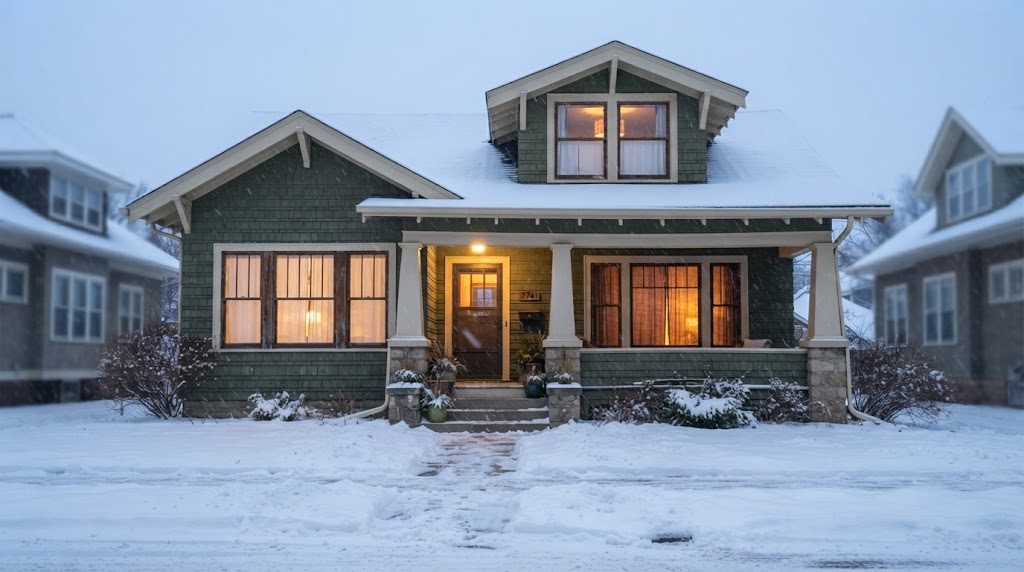
When I bought this house, I didn't see fourteen windows. I saw fourteen individual light-and-climate puzzles, each with its own orientation, its own draft pattern, and its own daily rhythm of sun and shadow. Five years later, every window has taught me something. Here's the tour.
The North-Facing Living Room Windows: The Draft Fighters
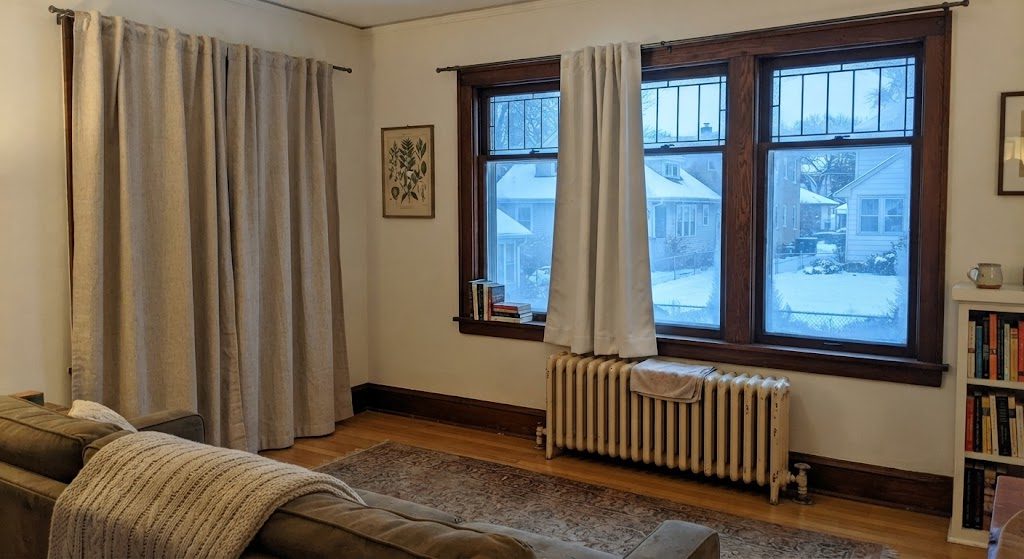
Three original double-hung windows line the north wall of my living room. They never get direct sun, which means they're cold from November through March. Steam radiators sit directly beneath each one, adding a layer of complexity.
What I Learned
North windows in a cold climate are thermal sieves. Even with storm windows, I could feel cold air rolling off the glass on January nights. The radiators below created a constant convection current: warm air rising, hitting cold glass, cooling, and dropping back down as a draft.
The solution wasn't a single heavy curtain—that just trapped cold air between the fabric and the glass while blocking the radiator's heat from reaching the room. Instead, I installed floor-length, tightly woven cotton duck panels mounted on extended brackets that clear the radiators by three inches. At night, the curtains fall to within a half-inch of the floor, creating a dead-air pocket that measurably reduces heat loss. During the day, I open them fully to let the radiators work.
The South-Facing Kitchen Window: The Sun Test
The kitchen has one large south-facing window above the sink. All-day sun, year-round. Steam from the kettle. Occasional cooking grease in the air. This window punishes fabric.
What I Learned
My first attempt was an unlined linen valance—beautiful for about eight months, then faded to a pale ghost of its original ochre and developed a permanent wave from humidity cycling. The replacement is a washable polyester-cotton blend with a UV-stable dye formulation, mounted as a simple cafe curtain on a tension rod. It handles steam without warping, goes in the washing machine monthly, and hasn't faded noticeably in two years. For a south-facing workhorse window, performance fiber beats natural fiber every time.
The East-Facing Bedroom: The Sleep Disruptor
I covered this in depth in another article, but the short version: east windows at dawn are merciless. This bedroom has two of them.
What I Learned
The only solution is a true two-layer system: blackout closest to the glass, sheer on a separate rod toward the room. The blackout panels stay closed until I wake up; the sheers provide privacy and let afternoon warmth through. The critical detail I didn't appreciate at first: the blackout rod must be mounted close enough to the frame that light doesn't leak around the edges. Side channels or wrap-around rods matter as much as the fabric.
The Bathroom Window: The Humidity Test
One small, west-facing window in the upstairs bathroom. Original wavy glass, no ventilation fan in the original design. Daily hot showers, Minneapolis winter condensation.
What I Learned
Natural fibers are a non-starter here. Cotton and linen absorb moisture and eventually mildew in this environment. My solution is a polyester moisture-resistant roller blind mounted inside the frame, topped with a decorative linen-blend valance set far enough forward to avoid direct steam contact. The blind does the work; the valance just looks good. Separating the functional layer from the decorative layer is the single smartest move in a high-moisture window.
The Drafty Hallway Window: The Insulation Lesson
A single, narrow window in the upstairs hallway. Original 1923 single-pane with a storm window added later. It rattles when the wind blows from the northwest.
What I Learned
This window taught me that fabric weight alone doesn't equal insulation. A loosely woven heavy fabric lets air pass through the gaps between yarns. What you need is density, not just heft. I hung a dense, interlined cotton panel that extends well beyond the frame on all sides. The interlining—a thin layer of flannel sandwiched between the face fabric and the lining—does the real thermal work. It's the same principle as a winter coat: it's not the outer shell that keeps you warm, it's the trapped air in the middle layer.
Fourteen Windows, One Principle
Every window in this house has its own job description. Some block light, some manage drafts, some survive steam. The curtain that works beautifully in the living room would fail in the bathroom. The kitchen solution would be useless in the bedroom. There is no universal best curtain—only the right fabric, in the right density, hung the right way, for that specific pane of glass.



No letters yet — be the first to write.