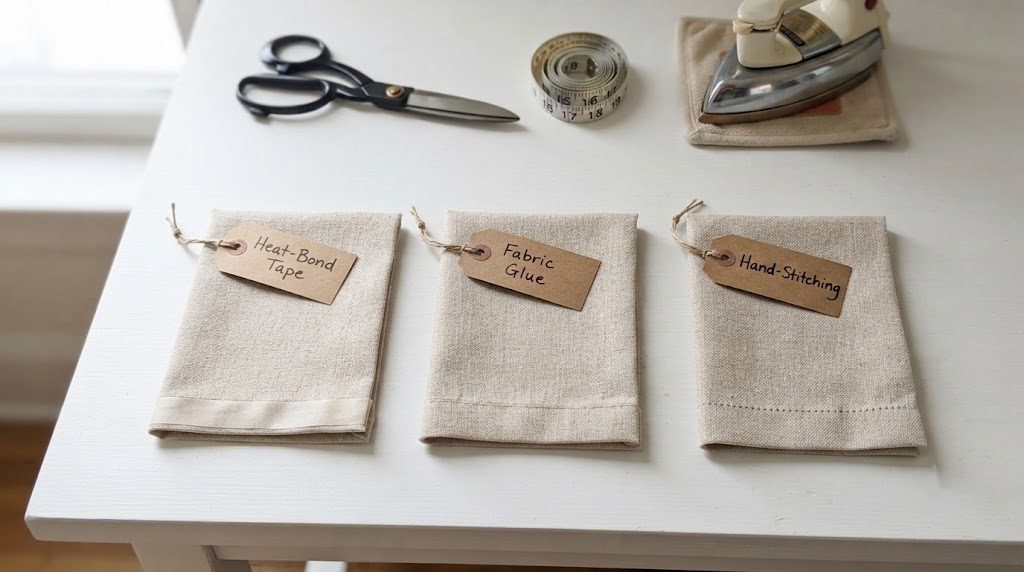
Curtains puddling on the floor might look romantic in a magazine, but in a home with pets, radiators, and weekly vacuuming, it's just a dirt trap. Hemming is essential, and not everyone owns a sewing machine. The good news: you can get a clean, durable hem without one. The catch: not all no-sew methods are equal, and your fabric type will disqualify some of them immediately.
I tested three common approaches—heat-bond tape, liquid fabric glue, and old-fashioned hand-stitching—on three curtain fabrics: a lightweight cotton voile, a midweight polyester-cotton blend, and a heavyweight linen. Here's what held and what failed.
Method 1: Heat-Bond Tape — Fast, but Demanding
Heat-bond tape is a thin adhesive web that melts under an iron, fusing two layers of fabric. It's the most popular no-sew method, and when it works, it looks crisp and professional.
The Test
I applied a leading brand of iron-on hem tape to all three fabrics, following the package instructions: press with a hot, dry iron for the specified seconds, let cool completely, then check the bond.
The Results
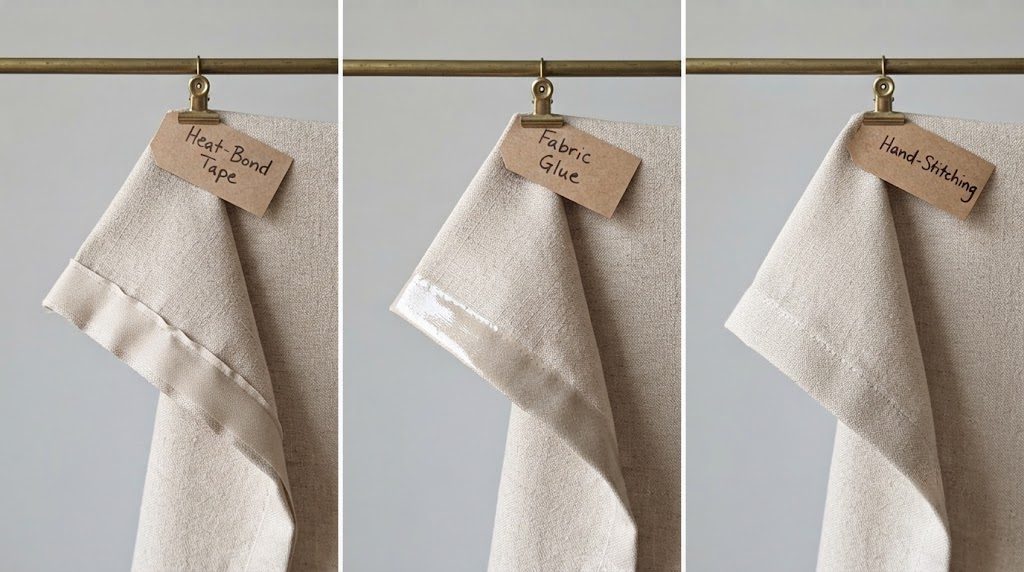
On the poly-cotton blend, the tape performed beautifully—strong hold, invisible from the front, and the hem stayed put after repeated shaking and light tugging. On the heavyweight linen, it held initially but began to peel at the corners after I handled the panel for a few minutes. The linen's natural texture and loose fibers simply didn't give the adhesive enough smooth surface to grip. On the lightweight cotton voile, the tape bled through slightly, leaving a faint shiny stripe visible from the right side. Worse, the intense heat required puckered the delicate fabric along the hemline. Heat-bond tape is a one-fabric wonder—reliable only on smooth, synthetic blends that can handle high heat.
Method 2: Liquid Fabric Glue — Tempting but Treacherous
Fabric glue promises an even easier fix: squeeze, press, dry. No iron, no skill. I tested a washable, clear-drying fabric glue highly rated online.
The Test
I applied a thin, continuous bead to each fabric, folded the hem, weighted it with books, and let it cure for 24 hours.
The Results
The glue created a stiff, slightly shiny seam line on every fabric. On the voile, it was a disaster—the glue soaked through and left a dark, translucent stain on the front that never fully disappeared. On the linen, the bond was brittle and cracked when I flexed the hem. The poly-cotton held acceptably, but the resulting hem felt like cardboard. More concerning: after one gentle hand-wash cycle, the glue bond on all three samples weakened noticeably. Fabric glue is useful for emergency repairs or temporary basting, but for a permanent curtain hem that needs to hang straight and move naturally, it's the weakest candidate.
Method 3: Hand-Stitching — Slow, Steady, and Surprisingly Learnable
The method our grandmothers used requires only a needle, thread, and patience. I used a simple blind hem stitch, which catches just a thread or two of the front fabric, making the stitches nearly invisible from the right side.
The Test
I hemmed each panel by hand, timing myself. The voile took twenty minutes per panel, the poly-cotton fifteen, the heavyweight linen nearly thirty—thicker fabric requires more effort per stitch.
The Results
On all three fabrics, the hand-stitched hem was the clear winner. It moved with the fabric instead of fighting it. There was no stiffness, no visible residue, no peeling. On the linen, the stitches settled into the weave and became essentially undetectable. After washing, every hem remained intact. The process is slower, yes—but a hand-stitched hem will outlast any adhesive product by years. It's also the only method that works reliably across all fabric types.
The Clear Winner, and When to Cheat
If you care about longevity and own curtains made of anything other than a poly blend, hand-stitching is the answer. It costs almost nothing, requires minimal skill to learn, and produces a hem that behaves like part of the fabric. If you're in a genuine time crunch and your curtains are a smooth synthetic blend, heat-bond tape is an acceptable shortcut—just test a scrap first. Fabric glue should be your last resort, reserved for hems no one will ever see or touch.
No letters yet — be the first to write.