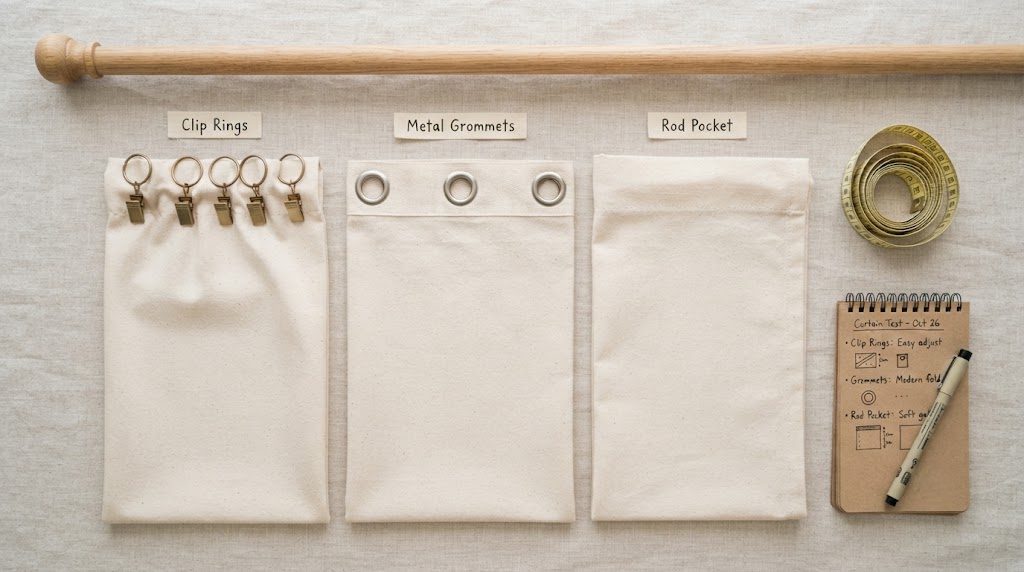
Most curtain shopping starts with fabric and color. The hanging method is an afterthought—a decision made at checkout when the website asks you to pick a header style. But the way a curtain attaches to its rod controls how it moves, how light leaks at the top, and whether you'll actually bother to open and close it every day. I tested three common header styles on the same window, using identical unlined cotton panels, to document exactly how each one performs.
The Test Setup
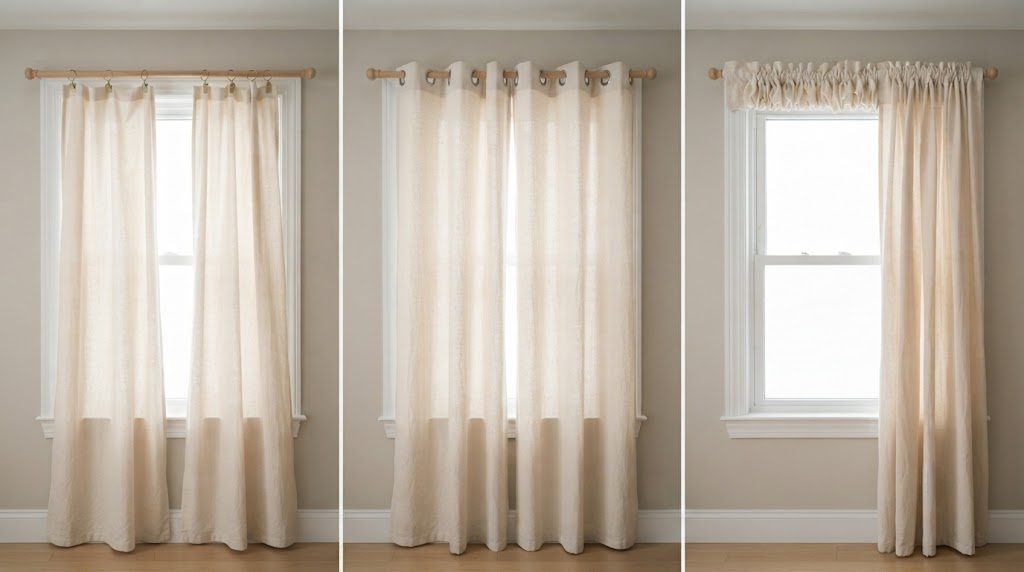
I mounted a standard 1⅜-inch wooden curtain rod on a north-facing bedroom window. I prepared three panels of the same midweight cotton, each 54 inches wide and 84 inches long. One panel got clip rings, one had sewn-in metal grommets, and one used a classic rod pocket. I hung each panel independently, opened and closed it twenty times, measured the light gap at the top, and photographed the drape from the same angle. Here's what I found.
Clip Rings: The Smoothest Operator
Clip rings are metal or resin rings that attach to the top hem of the curtain with small spring-loaded clips. The rings then slide directly onto the rod.
The Advantages
Clip rings glide. On a smooth wooden rod, they move with almost no resistance, which means you'll actually open and close the curtains instead of yanking once and giving up. They also add about 1½ inches of drop length, so a panel that's slightly short can be rescued. The clips create a soft, even ripple of folds that looks tailored without being stiff.
The Disadvantages
Each clip creates a small pinch point on the fabric. Over months of daily use, those pinch points can leave permanent impressions, especially on softer fabrics like linen or lightweight cotton. The gap between rings also allows some light to leak between the top of the curtain and the rod. On a bedroom window where morning light is the enemy, that gap matters. Finally, good-quality rings with smooth-gliding finishes cost more than a basic grommet or rod pocket panel, and you need enough rings—one every 4 to 6 inches—for the panel to hang evenly.
Grommets: The Modern Look with a Mechanical Limit
Grommets are metal rings punched and sewn directly into the curtain header. The rod threads through the grommets, creating wide, even folds.
The Advantages
Grommets create the most dramatic, uniform folds of the three methods. The pleats are deep and architectural, which suits a contemporary space. The metal rings won't pinch or wear the fabric the way clips can. Because the grommets are relatively large, the curtain slides easily on most standard rods—though not quite as effortlessly as clip rings.
The Disadvantages
Grommets are noisy. Metal sliding on metal or metal on wood produces a distinct zipping sound that can be startling in a quiet room. The large openings also create a significant light gap at the top, typically larger than clip rings because the rod sits further from the wall. In my test, the grommet panel showed the most light leak at the header, measuring nearly an inch of visible sky between the rod and the top of the fabric. Grommets also require removing the entire rod to take the curtains down for cleaning, which is a genuine annoyance.
Rod Pocket: The Quiet Classic with a Friction Problem
A rod pocket is simply a fabric sleeve sewn into the top of the curtain through which the rod passes. It's the oldest and simplest method.
The Advantages
Rod pocket curtains are the quietest option—no metal, no clicks, no zipping. They create a soft, gathered look that suits traditional and casual spaces. They also block the most light at the top because the fabric bunches directly against the rod, leaving minimal gaps. For a bedroom where blackout matters, rod pockets seal the header better than any other method.
The Disadvantages
Rod pocket curtains are hard to open and close. The fabric bunches and binds against the rod, requiring two hands and patient shimmying to move the panel across. After twenty cycles in my test, I was already avoiding the task. In a room where curtains stay open or stay closed permanently, this doesn't matter. In a bedroom or living room where you adjust the curtains daily, rod pocket friction will test your patience within a week. They're also the hardest to remove for cleaning—you must slide the entire panel off the rod, which often means removing finials or brackets.
My Verdict, by Priority
For daily operation and ease, clip rings win without contest. For light control at the top, rod pockets are the clear choice. For a modern look with deep, uniform folds that never need adjusting, grommets hold their own. My own house uses clip rings in the living room and bedroom where curtains move daily, and rod pockets in the guest room where they stay closed for months. The right answer depends entirely on how you live with the curtain once it's up.

No letters yet — be the first to write.