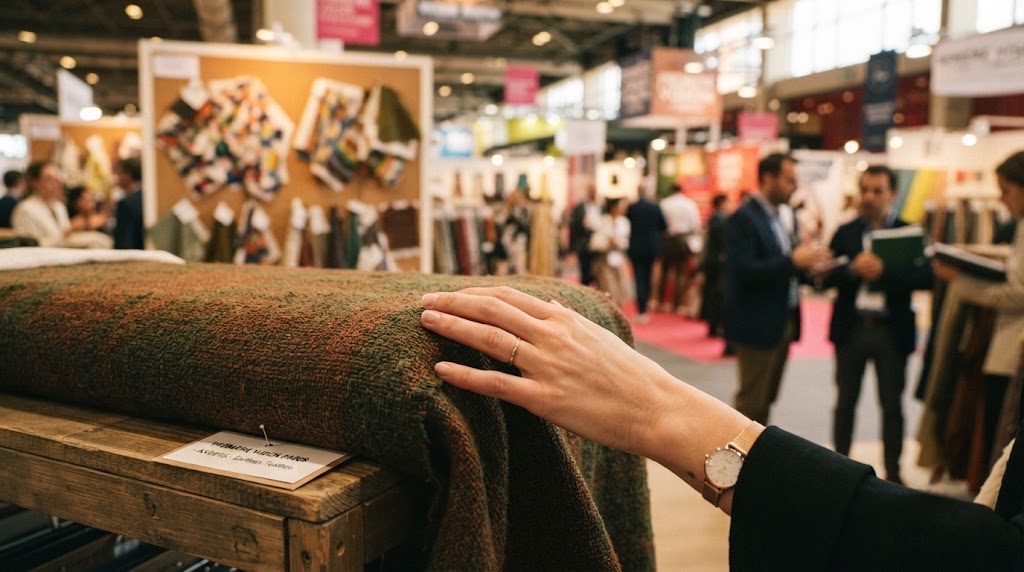
Première Vision isn't a trade show for finished curtains. It's earlier than that—further upstream, where mills from Italy, Japan, Turkey, and beyond show their newest constructions to the designers and manufacturers who will turn them into products three years from now. Walking the aisles in February, I'm not looking for colors or patterns. I'm feeling for shifts in how fabric is being built. Here are three I'd bet on.
Trend 1: Textural Transparency — When Sheers Grow Teeth
The sheer curtain category has been stuck for a decade. Polyester voile, maybe a little linen gauze if you're feeling fancy. This year, the mills are rethinking transparency from scratch.
What I Saw
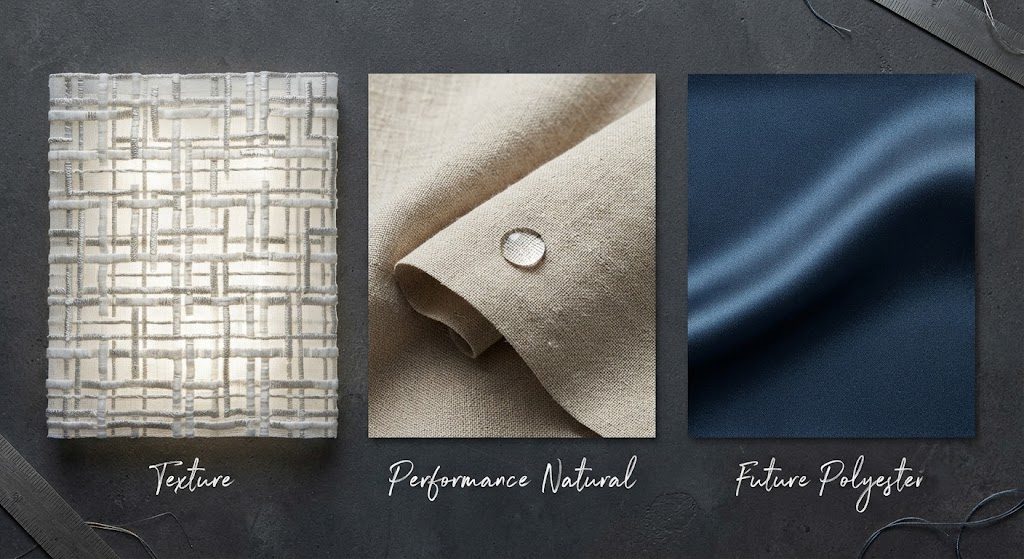
Across multiple European mills, I handled sheers that refuse to be flat. One Italian weaver showed a 100% linen sheer with an undulating, almost three-dimensional surface created by alternating thick and thin weft yarns. A Japanese mill presented a polyester-linen blend sheer with a subtle grid pattern woven in relief—close up, it reads as architectural; from across a room, it's still soft and ethereal. Another standout: a recycled polyester sheer with a crinkled, papery hand that looked fragile but stretched without deforming.
What unifies these fabrics is texture that works with light rather than simply allowing it to pass. The uneven surfaces break up the beam of direct sun, casting softer, more complex shadows inside the room. By 2028, the flat sheer is going to look dated.
Trend 2: Performance Naturals — Wool, Hemp, and Linen That Do More
For years, "performance fabric" meant polyester. Stain-resistant, UV-stable, waterproof—and unmistakably synthetic to the touch. The mills at this year's show are chasing something harder: natural fibers that behave like synthetics without losing their soul.
What I Saw
A Belgian mill introduced a heavyweight linen with a nano-finish that repels water without changing the hand or breathability. The water beaded and rolled off, but the fabric still felt like dry, slubby linen. A Scottish weaver brought a merino wool drapery fabric blended with flax—a combination I'd never seen before—that had the softness of wool, the body of linen, and inherent flame resistance that requires no chemical treatment. And hemp, long relegated to the eco-niche, appeared in refined, dye-friendly weaves that draped with the weight of a midweight cotton sateen.
This trend is driven partly by European Union textile regulations tightening around synthetic microplastic shedding, but the appeal for the American consumer will be simpler: curtains that feel beautiful, work hard, and don't rely on a chemistry lab to perform.
Trend 3: The Quiet Death of Disposable Polyester
The era of the $19 polyester curtain panel that disintegrates after two years of sun exposure is ending—not because consumers are revolting, but because mills are losing the ability to produce it profitably.
What I Saw
Several mills that historically specialized in bottom-tier polyester flat weaves have pivoted entirely to recycled polyester constructions with demonstrably higher thread counts and better UV stabilization. The price floor is rising, and the quality floor is rising with it. I handled a recycled polyester sateen from a Turkish mill that had the luster and drape of a midrange cotton sateen from five years ago. Another Japanese supplier showed a polyester curtain fabric designed for disassembly—the face fiber, lining fiber, and stitching thread are all chemically compatible so the entire panel can be recycled without separation.
The takeaway for the consumer is this: by 2028, the polyester curtain you buy off the shelf will be better-made than what you're buying today, not because of altruism, but because the economics of waste and regulation have caught up. The cheap panel won't vanish, but its quality baseline will rise enough that the "just buy new ones" mentality becomes harder to justify—and that's a good thing.

No letters yet — be the first to write.