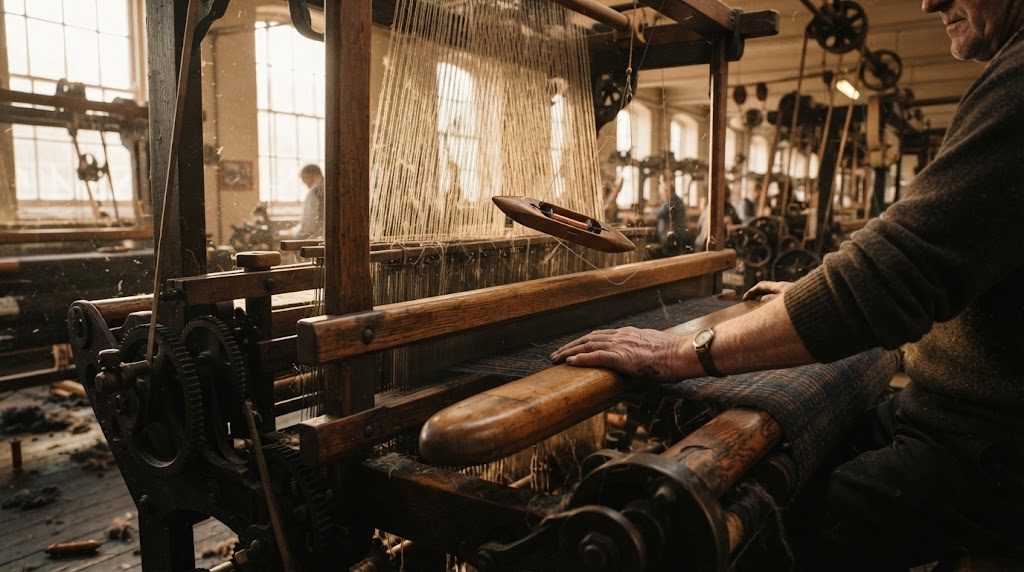
The Faribault Woolen Mill sits beside the Cannon River in southern Minnesota, a brick-and-timber monument to American textile manufacturing that has operated continuously since 1865. I've read about its looms for years. Last month, I finally stood beside them.
Most people visit historic mills for the architecture or the gift shop. I went to watch the machines. What I learned in two days of observing, touching, and asking questions changed how I think about the fabric hanging in my own windows.
The First Thing You Notice: Sound
Before you see anything, you hear it. The mill floor isn't deafening—it's rhythmic. A deep, wooden thump every two seconds as the beater on a century-old Crompton & Knowles loom packs each weft yarn into place. Modern high-speed looms produce a blurred, high-pitched rattle. The old looms run at roughly one-tenth the speed, and you can hear the difference. Each pick is a distinct event. Each insertion of the shuttle is a decision, not a blur.
This pace isn't inefficiency. It's a different philosophy of fabric construction. When the loom runs slowly, the yarns have time to settle. The weft isn't slammed into place by a machine running at the edge of its mechanical tolerance. It's guided, packed, and allowed to relax between beats. The resulting fabric has a structural integrity that a high-speed loom can approximate but never quite replicate.
What a 160-Year-Old Loom Does That a Modern One Can't
The Shuttle Difference
Modern looms largely use projectile, rapier, or air-jet systems to carry the weft yarn across the warp. These are fast and precise, but they treat the weft as a passive element—a thread to be delivered from point A to point B. A shuttle loom, by contrast, carries the yarn package inside a wooden boat that physically travels through the warp shed. The yarn unwinds under its own tension, guided by the shuttle's weight and the weaver's settings, not by a burst of compressed air.
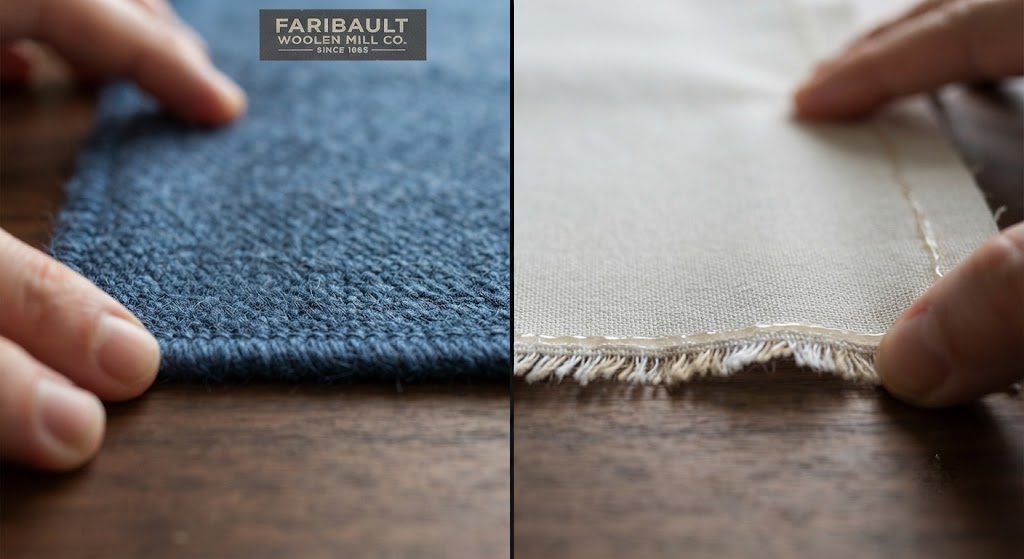
The result is a fabric with a different hand. The yarns are less stressed during weaving. The tension across the width of the cloth is more consistent. The selvedge—the self-finished edge that prevents unraveling—is formed naturally by the continuous weft yarn looping back on itself, rather than being trimmed and sealed with adhesive. A shuttle-woven selvedge is a thing of functional beauty: strong, smooth, and permanent.
Density Without Rigidity
I handled a bolt of wool blanket fabric that had just come off the loom—the same design Faribault has produced for over a century. The weave density was extraordinary, with picks per inch that would challenge a modern high-speed loom to achieve without breaking yarns. Yet the fabric was supple, not stiff. The slow beat allowed the yarns to nest together without crushing. You could feel the difference between density achieved through patient packing and density achieved through brute force.
This matters for curtains. A densely woven curtain fabric that's been produced on high-speed equipment often has a hard, flat hand—it blocks light but hangs like a board. A shuttle-woven dense fabric retains movement and drape. It's the difference between a material that merely performs and one that performs while still feeling alive.
The Fiber Knowledge Embedded in Old Machines
The mill's veteran weavers—some of whom have worked these looms for forty years—adjust machine settings not by digital readout but by feel, sound, and observation. One weaver showed me how she checks warp tension by pressing two fingers on the sheet of threads and reading the give, the way a baker reads dough. When the humidity changes in the mill—Minnesota summers are humid, winters bone-dry—the wool's behavior changes, and she compensates by ear, listening for the shuttle's flight path.
This level of attention to fiber behavior is something I've tried to bring to curtain evaluation my entire career. The fiber tells you what it needs if you're willing to listen. The loom operator doesn't force wool to behave like cotton. She respects the material's nature and adjusts the process accordingly. The same principle applies to choosing curtains: the fabric should dictate the application, not the other way around.
What I Brought Home
I left Faribault with a wool throw blanket—the obvious souvenir—but also with a conviction that has nothing to do with wool. The best fabric isn't necessarily the most technologically advanced. It's the fabric made with enough time for the fibers to find their natural equilibrium. Whether you're weaving a blanket on a 19th-century loom or evaluating a curtain panel on a store shelf, you're looking for the same thing: evidence that the material was respected, not rushed.


No letters yet — be the first to write.