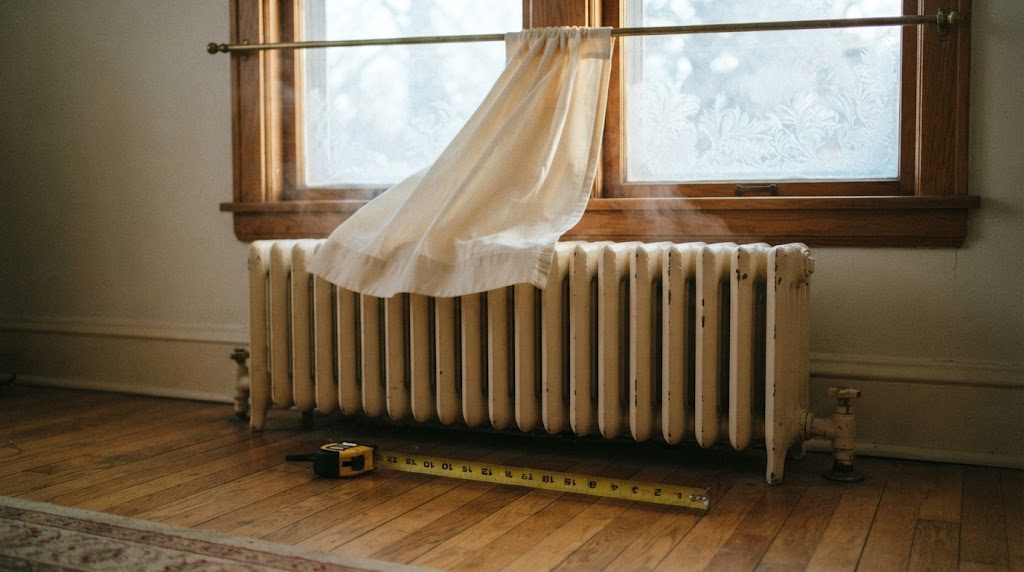
In a perfect world, radiators would live in the middle of the wall, far from windows and the curtains that cover them. In the real world—especially in prewar houses and apartments across the northern United States—the radiator sits directly under the window. The logic was sound in 1920: the coldest air enters at the glass, the radiator heats it as it descends, and the room stays warm. But that logic never accounted for floor-length curtains.
If you hang drapes without considering the radiator, you create a cascade of problems: trapped heat, wasted energy, potential fire risk, and curtains that billow and suck against cold glass. The solutions aren't complicated, but they require understanding how heat actually moves through your window bay.
The Safety Baseline: Clearance and Contact
How Close Is Too Close
A steam radiator can reach surface temperatures of 215°F or higher. Most curtain fabrics begin to scorch or degrade between 250°F and 300°F, but sustained exposure to lower temperatures weakens fibers and finishes over time. Cotton and linen can yellow and become brittle. Polyester can melt or glaze. Even if the fabric never ignites, heat damage is cumulative.
The absolute minimum clearance between any curtain fabric and the top or front of a radiator is six inches. For steam systems, twelve inches is safer. If your radiator has a cover or enclosure, the surface temperature drops significantly, and clearance requirements relax—but never let fabric rest directly on any radiator surface, covered or not.
The Airflow Problem Nobody Mentions
Why Your Curtains Are Making the Room Colder
A curtain that falls between a radiator and the room does something counterintuitive: it traps heat behind itself, warming the window glass and the outdoor air while the room stays cold. Meanwhile, cold air pooling at the glass drops down behind the curtain and spills out at the floor as a draft. You've essentially built a chimney that sends warm air outside and drafts cold air in.
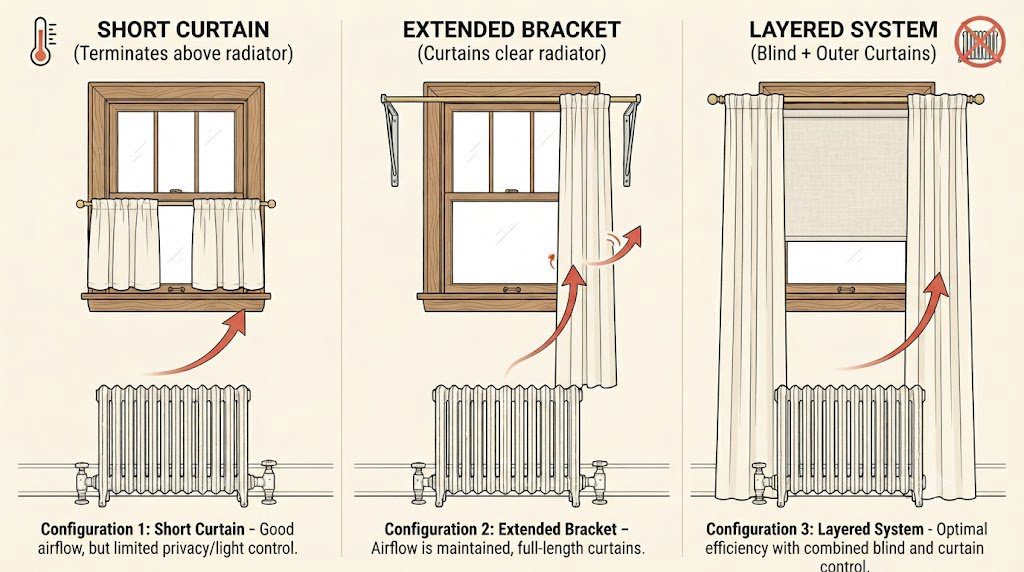
The fix is to direct heated air into the room, not into the space between the curtain and the window. This means either stopping the curtain above the radiator or holding it away from the radiator's front plane so that warm air can rise unimpeded into the living space.
Three Solutions That Actually Work
Solution 1: The Short Curtain (Simplest)
Hem your curtain panels to finish one to two inches above the top of the radiator. This leaves the radiator fully exposed and functional. Pair with a window sill-depth shelf or a radiator cover that acts as a shelf to bounce heat forward. This is the most straightforward solution for casual spaces like kitchens, bathrooms, or hallways. The downside is aesthetic: some rooms demand the drama of full-length curtains, and a short panel can look truncated.
Solution 2: The Extended Bracket (Best Compromise)
Mount your curtain rod on deep brackets that hold the fabric at least six to eight inches out from the wall, clearing the front face of the radiator entirely. The curtain then falls straight to the floor without ever crossing over the radiator's heat path. Warm air rises freely between the window and the curtain, spilling into the room above the rod. This preserves full-length drape while protecting the fabric and maintaining radiant heat delivery. For this to work, your rod must be sturdy—heavyweight brackets anchored into studs or solid blocking, not drywall anchors alone.
Solution 3: The Layered Approach (Most Flexible)
Combine a radiator-hugging thermal blind mounted inside the window frame with full-length decorative curtains on extended brackets. The blind does the insulation work and can be lowered to knee-height above the radiator; the outer curtains frame the window without interfering with heat flow. This is the system I use in my own living room, and it handles Minneapolis January nights without sacrificing either warmth or appearance.
Fabric Choices That Handle Heat Better
Natural fibers tolerate proximity to heat better than synthetics. Cotton and linen will scorch at high enough temperatures, but they won't melt or drip. Polyester, nylon, and acetate soften and deform at lower temperatures and can melt onto a hot radiator surface. If your curtains must pass near a radiator—even with clearance—choose natural fibers or high-temperature-resistant synthetics like solution-dyed acrylic. And never, ever use blackout curtains with a foam or acrylic backing close to a heat source. That coating is the first thing to fail.



No letters yet — be the first to write.