
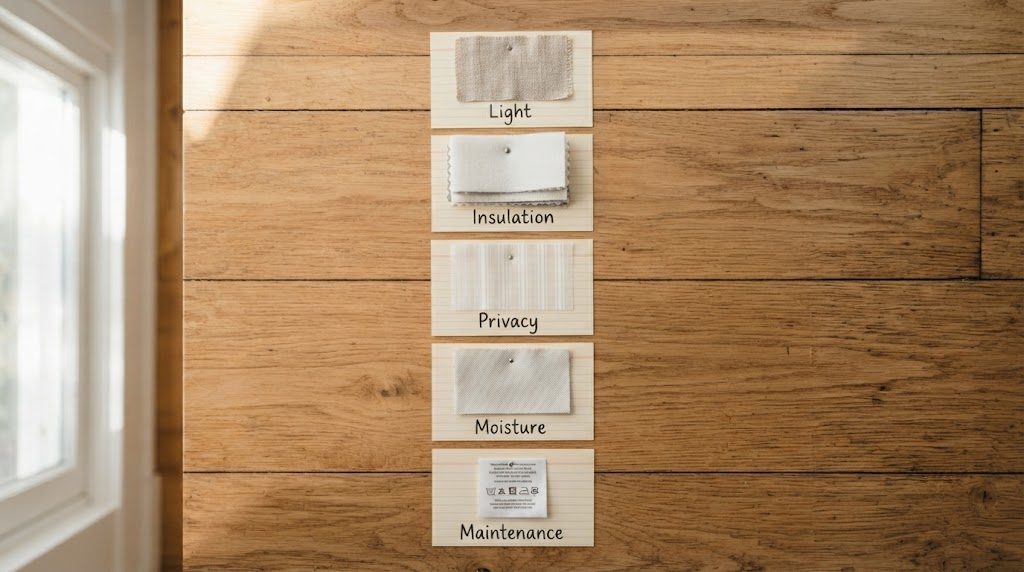
A curtain’s job description is deceptively long. It manages daylight, helps hold heat inside, blocks the neighbor’s view, tolerates humidity, and survives everything from toddler hands to dry cleaning. If you choose based on color alone, you’re hiring someone who looks great in the interview but can’t do the work. To get it right, slow down and run every candidate through these five questions.
1. What Does This Window Actually Need from Light Control?
Light isn’t just “bright” or “dim.” A north-facing window delivers steady, cool, indirect light all day; a west-facing window blasts low-angle, hot sun in the afternoon. Before you choose fabric, define the job.
Sheer, Filtering, Room-Darkening, or Blackout
If the room only needs a softened glow and some daytime privacy, a light sheer or semi-sheer will do. For a bedroom that must be dark for sleep, you need full blackout—not just a dark color, but a dense weave or a true opaque lining. In a home office with afternoon glare, the curtain should diffuse light enough to keep your screen readable, without leaving you in a cave at noon. Be specific: name the hours when the window causes trouble.
2. How Much Insulation Is Worth Paying For?
In a cold climate, a curtain is essentially a movable wall. But not every window needs the thermal treatment.
The R-Value Talk That Saves You Money
Curtains can reduce heat loss, but the effect is proportional to coverage, seal, and fabric thickness. A tightly closed, floor-to-ceiling, heavy cotton duck or interlined drape will measurably lower a drafty window’s heat loss. The flip side: spending extra on a “thermal” labeled curtain with a thin, shiny foam backing often pays for marketing, not performance. Look for dense weaves, multiple layers, and a fit that prevents warm air from circulating behind the fabric. In rooms you rarely use, basic insulation is enough; in the living room where you sit beside glass, invest in real textile thermal mass.
3. Who Can See In, and When?
Privacy is time-stamped. The same sheer curtain that offers perfect daytime privacy—when it’s brighter outside than inside—turns into a transparent window display as soon as you switch on a lamp after dark.
Daytime Privacy vs. Nighttime Exposure
Map out your room’s sight lines. The kitchen window facing the backyard may only need a cafe curtain for daytime use. The street-facing bedroom demands a dual layer: a privacy sheer for daylight hours and a blackout or heavy drape you draw fully at night. If you live in an urban area with streetlights, test fabrics at home with a flashlight at night—some weaves become see-through under artificial light even when they feel opaque in the store.
4. Will Moisture Kill This Fabric?
Bathrooms, kitchens, and even windows near radiators with occasional condensation demand moisture-resistant thinking.
Bathrooms, Kitchens, and the Condensation Factor
Pure cotton and linen breathe beautifully, but they absorb moisture and can develop mildew in persistently damp conditions. For a bathroom window, consider polyester or a high-performance polyester blend that resists mold and dries quickly. In the kitchen, near a steam-producing stove or kettle, avoid unlined natural fibers that will trap cooking odors and warp with humidity changes. If you love the look of natural fabric in a moisture-prone spot, use it as a decorative outer layer and keep a moisture-resistant roller blind behind it doing the actual work.
5. Can You Actually Live with the Maintenance?
Before you hand over your credit card, read the care label as if it’s legally binding—because it practically is. A dry-clean-only curtain in a home with kids, pets, or dust allergies becomes a recurring expense and a logistical headache.
The Care Label Test
Machine-washable fabrics like cotton, polyester, and some poly-cotton blends are the most forgiving. Linen can often be washed on gentle and line-dried, but it shrinks. Silk taffeta is beautiful and fragile—keep it far from sunlight and food. If you’re buying expensive custom drapes and can commit to professional cleaning, that’s fine. But for the curtain that will catch the dog’s muddy tail, choose washable. The question isn’t just “Can it be cleaned?” It’s “Will I clean it as often as it needs?”
Start every curtain search with these five answers written down. It’s the cheapest insurance against the expensive mistake of buying a curtain that looks right but works wrong.



No letters yet — be the first to write.