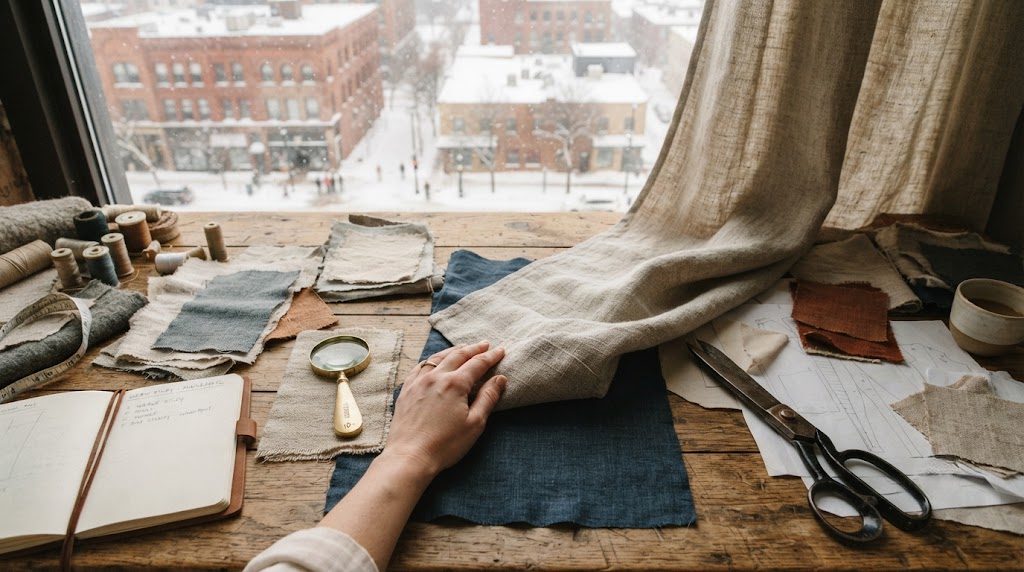
If you’ve ever stood in front of a wall of curtain swatches — linen blends on the left, polyester velvets on the right — and felt completely unmoored, you’re in good company. The lighting in the store is wrong, the sample feels nothing like what you’d hang at home, and the price tags make no sense. One panel costs $39; another, nearly identical to the eye, costs $280. What are you paying for? The brand? The design? Or is there something woven deep into the cloth itself?
I’m Paul Landry, and I’ve spent my entire career trying to answer that question from the inside. For twelve years, I worked in fabric development for one of the country’s largest window-covering manufacturers. My job was to write the internal spec sheets that the industry’s own designers relied on — fiber content, weave density, light-fastness ratings, thermal resistance, seam strength. I tested fabrics in climate chambers, put them under UV lamps for hundreds of hours, and watched how they behaved on traverse rods in a Minneapolis January.
When I left to start my own consultancy and this blog, I did it because I was tired of reading curtain advice that never mentioned the very thing that makes a curtain work: the fabric.
The Problem with Most Curtain Advice
Open any curtain buying guide, and you’ll be greeted by two extremes. On one side, the pure-aesthetic camp: “These breezy linen drapes will brighten your space!” — with no mention of why they’ll sag into a wrinkled mess by February if you live anywhere with real winter. On the other side, the pure-utility camp: a blackout curtain roundup that rates panels purely by price and a “darkness score,” ignoring how a cheap foam backing will break down in three years and off-gas in your south-facing bedroom.
Neither camp understands fabric. Neither explains why one bolt of cloth costs $12 a yard and another costs $120. And neither gives you the tools to build your own judgment, so that the next time you walk into a store, you’re not just picking a color — you’re reading the weave.
That’s what Drape Language is here to change.
Why I’m Building Drape Language
A Shared Language for the Fabric-Curious
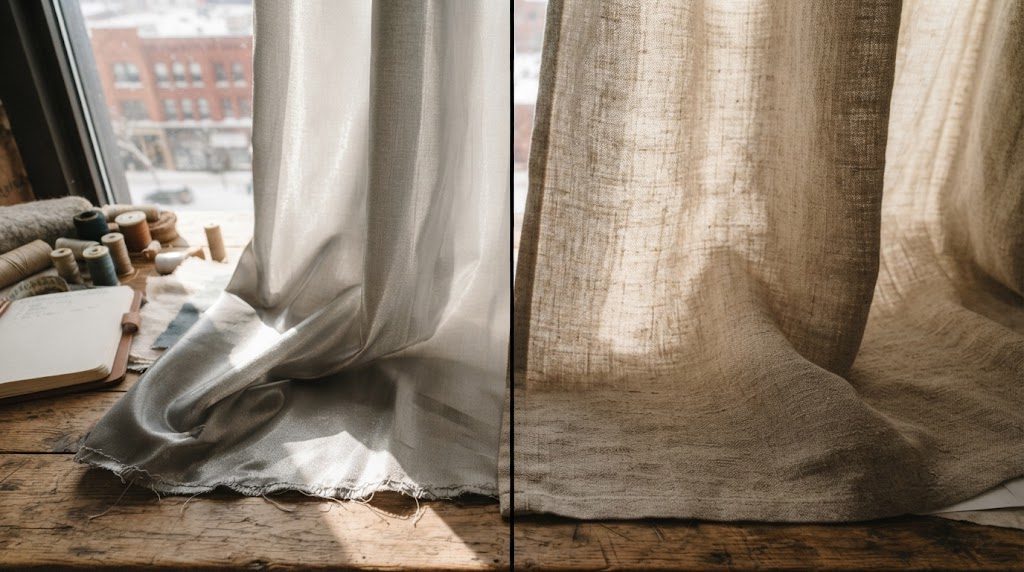
You don’t need a textile degree to understand what makes a good curtain. You need someone willing to hand you the swatch and say, “Feel this — the stiffness you’re noticing? That’s the sizing. Now compare it to this one over here. See how it falls? That’s the drape coefficient.” I’ll always define the terms, and I’ll never talk down to you. My goal is to make you fluent in the language your curtains are already speaking.
Respect for Your Budget and Your Climate
I live in a 1920s Craftsman in Minneapolis with fourteen original double-hung windows, steam radiators, and a draft problem I’ve spent five years solving with the right textiles. I know cold climate window coverings because I live them. I’ll help you spend where it counts — on a dense, light-locking weave for a north-facing nursery — and save where it doesn’t, like skipping the expensive “thermal” label when a simple cotton duck with a proper lining does more.
Performance Over Pretty Pictures
Curtains are the hardest-working soft furnishing in your home. They manage light, insulate against cold, block prying eyes, and absorb sound — all while hanging in direct sun, near radiators, and sometimes in the path of condensation. Every article on Drape Language starts from that premise: performance first, because even the most beautiful curtain fails if it doesn’t do its job.
What You’ll Get Here (and What You Won’t)
You’ll get: fiber-level explainers, side-by-side swatch tests, room-by-room strategies that account for window orientation and radiator placement, honest brand comparisons, and dispatches from textile mills and trade fairs that only a fabric nerd would think to write.
You won’t get: empty trend reports, “Top 10 Curtains for a Cozy Vibe” lists, or any product recommendation I haven’t handled myself or at least reviewed a full spec sheet for. I’m not an influencer. I’m a textile scientist who believes that understanding your curtains — right down to the thread — makes your home more comfortable, more efficient, and yes, more beautiful.


No letters yet — be the first to write.