
Walk into any well-appointed hotel room, and you'll notice something: the window isn't dressed with one curtain. There's a sheer closest to the glass, a blackout panel in the middle, and often a decorative drape on top. This isn't excess—it's engineering. Each layer does one job extremely well instead of one layer doing three jobs poorly.
The single-panel approach is the most common mistake in home curtain buying. We buy one set of curtains and expect them to provide daytime privacy, nighttime darkness, thermal insulation, UV protection for furniture, and a pulled-together look for the room. No fabric can do all of that. The layering principle splits these demands across dedicated materials.
The Three-Layer System, Explained
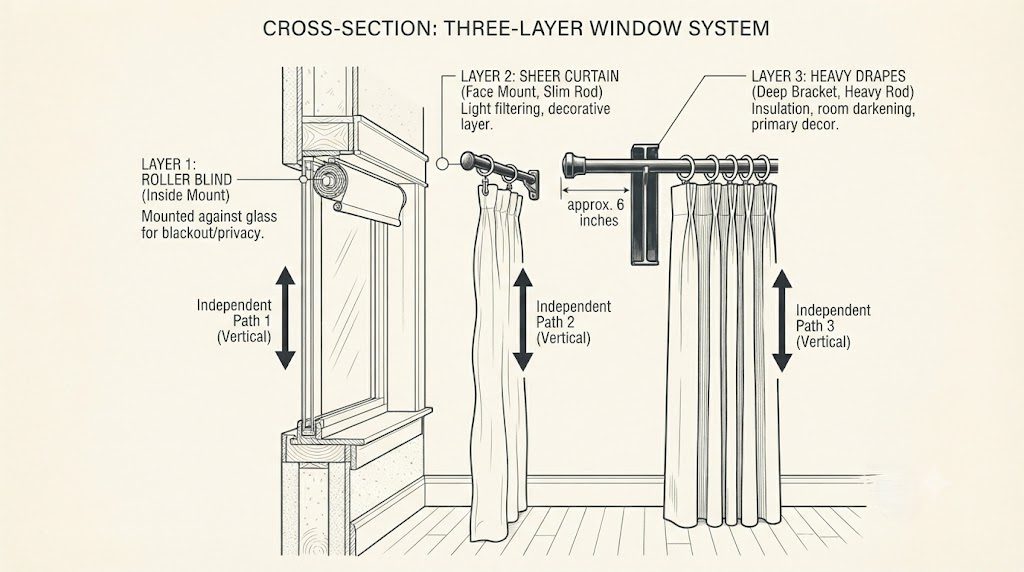
Layer 1: The Workhorse (Closest to the Glass)
This is the functional core. It handles privacy, light control, and often insulation. Depending on the room, this could be a polyester roller blind, a cellular shade with real R-value, a moisture-resistant vinyl blind for the bathroom, or a dense-weave blackout panel. This layer takes the daily abuse: it gets raised and lowered, touched by condensation, and blasted by UV.
Choose this layer based on the room's primary functional need. A bedroom gets blackout here. A living room might get a light-filtering honeycomb shade that provides privacy and insulation without total darkness. The key is that this layer doesn't need to be decorative—it needs to perform. It lives closest to the glass, so it's partly hidden by the layers in front of it.
Layer 2: The Soft Filter (The Middle Layer)
A sheer or semi-sheer panel sits on its own rod, between the workhorse and the decorative outer layer. Its job is nuanced: it diffuses daylight, provides soft daytime privacy when the blackout layer is open, and prevents the window from looking like a hard, bare hole in the wall when the heavy drapes are drawn back.
This layer is what makes a room feel finished during daylight hours. Without it, you have a binary choice: total darkness or total exposure. With it, you get a third state—soft, filtered light that still feels private. The fabric should be lightweight and airy: cotton voile, linen gauze, or a quality polyester sheer. It doesn't need to be blackout. It doesn't need to be thermal. It just needs to look beautiful with light passing through it.
Layer 3: The Decorative Frame (Closest to the Room)
This is the layer you see most. Heavyweight drapes in linen, cotton, velvet, or a considered blend, mounted on the outermost rod with decorative hardware. These panels frame the window, absorb sound, add color and texture to the room, and—when drawn—provide an additional insulation layer and complete darkness.
Because the functional heavy lifting is done by layers one and two, these outer curtains don't need to be blackout. They can be unlined linen or lightweight cotton if that suits the room's aesthetic. This freedom opens up fabric choices that would be impractical in a single-layer system. You can choose based on color, texture, and drape rather than light-blocking performance.
When Three Layers Are Overkill
Not every window needs the full system. A guest bedroom that's used twice a year might be fine with a single blackout panel. A kitchen window that faces the backyard needs moisture resistance and privacy, not three rods of fabric. The principle isn't about maximizing complexity; it's about matching layers to demands. If a window only needs privacy and moisture resistance, one well-chosen layer is the right answer.
The Hardware You'll Need
A three-layer system requires three separate mounting positions. The workhorse layer mounts inside the window frame or directly on the casing. The sheer layer mounts on a slim rod positioned just outside the frame. The decorative layer mounts on a heavier rod extended far enough to clear both inner layers, typically six to eight inches from the wall. This sounds complicated, but the brackets are standard hardware-store items. The only real requirement is that you install them in the right order, from the glass outward, ensuring each layer slides independently without tangling.
The Payoff
The first time you lower your blackout shade for a movie at 2 p.m. while the sheer still glows softly behind it, or you open the heavy drapes on a winter morning to let sunlight flood through the privacy layer while the insulated shade holds heat at the glass, you'll understand why hotels and theaters use this system. It's not about luxury. It's about giving each fabric a single, clear job—and letting it do that job well.



No letters yet — be the first to write.