If a curtain package says "linen blend," what do you picture? Probably a fabric that is mostly linen, with perhaps a little cotton or polyester added to control wrinkles and cost. That's a reasonable assumption. It's also frequently wrong.
Unlike "100% linen," the term "linen blend" has no legal minimum. A fabric containing 5% linen and 95% viscose can legally wear the same label as one with 80% linen and 20% cotton. The only way to know what you're buying is to check the fiber content tag — and even then, you're trusting the manufacturer's word. I decided to verify that word in a lab.
The Test Setup
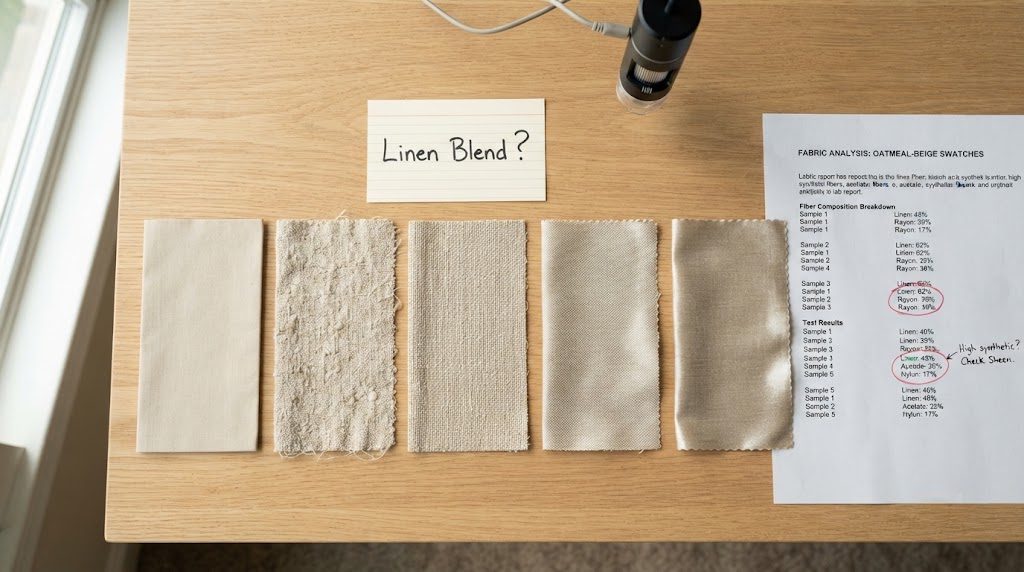
I selected five popular curtain panels from major online retailers, all marketed with "linen blend" prominently in the product name or description. The price range was wide: from $34 to $189 per panel. All were described as neutral, oatmeal or natural tones, and all were labeled as suitable for living areas. I cut a small swatch from the hem allowance of each panel, assigned them anonymous codes, and sent them to an independent textile testing lab for quantitative fiber analysis.
The lab used standard dissolution and microscopy methods to determine exact fiber percentages. What came back was a clearer picture of the curtain market's linen problem than I expected.
The Results: Five Brands, Five Surprises
Brand A: The Budget Option ($34)
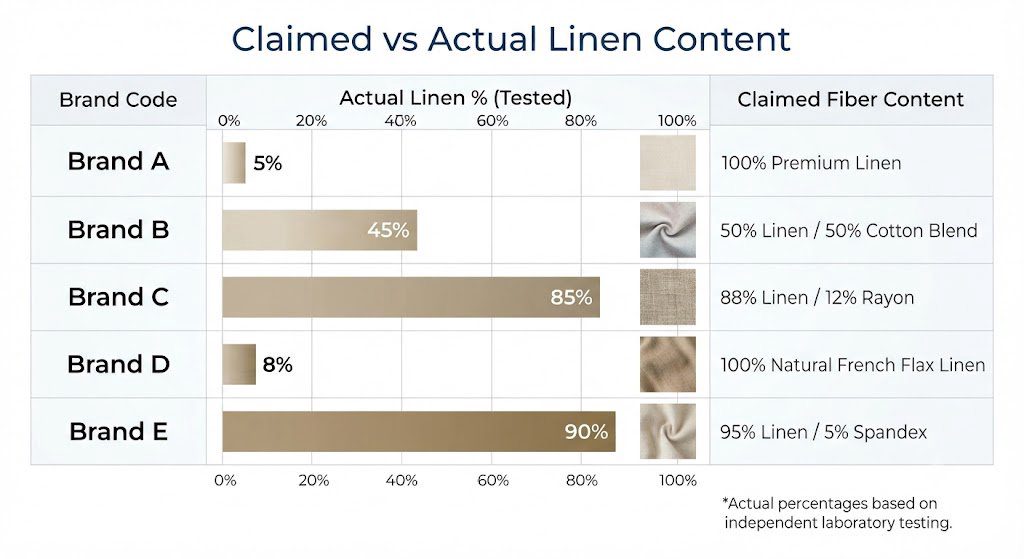
Claimed: "Linen blend." Actual content: 5% linen, 70% polyester, 25% viscose. This panel looked like linen in the product photo — the photography team had done excellent work capturing texture that barely existed. In hand, it felt unmistakably synthetic, with a slight plastic sheen the screen hid. The 5% linen appeared to be short, waste fibers added more for labeling rights than performance.
Brand B: The Mid-Range Mystery ($78)
Claimed: "Linen-cotton blend." Actual content: 12% linen, 48% cotton, 40% polyester. This was at least honest about the cotton presence, but the linen percentage was still lower than any shopper would guess. The polyester content explained the fabric's crisp drape and wrinkle resistance, but it also meant the panel lacked the breathability of a true linen-cotton blend.
Brand C: The Honest Performer ($112)
Claimed: "55% linen, 45% cotton." Actual content: 55% linen, 45% cotton. Exactly as stated. This panel, from a smaller manufacturer specializing in natural fibers, matched its label precisely. It had the slubby texture and relaxed drape of real linen-cotton, and the price reflected genuine material quality. No deception, no padding.
Brand D: The Viscose Impersonator ($95)
Claimed: "Premium linen blend." Actual content: 8% linen, 82% viscose, 10% polyester. This was the most egregious of the group. Viscose, a regenerated cellulose fiber made from wood pulp, can mimic linen's soft hand and subtle luster, but it lacks linen's strength, thermal properties, and crisp drape. It also wrinkles differently — more like a crushed tissue than linen's structured crease. This panel was essentially a viscose curtain with a linen price tag.
Brand E: The High-End Standard ($189)
Claimed: "70% linen, 30% cotton." Actual content: 68% linen, 32% cotton. Within an acceptable 2% tolerance, this panel delivered what it promised. The fabric had the weight, hand-feel, and drape of a genuine high-linen blend. The price was steep, but the material was real.
What This Means for Your Shopping
First, price correlates loosely with linen content — but brand D proves you can pay $95 for 8% linen. Price alone isn't a reliable guide. Second, always find the care label or online specifications tab that lists exact percentages. If a product page says "linen blend" but never gives a number, assume the number is low. Third, order swatches and use the crinkle test: a fabric with significant linen will hold a sharp crease; a fabric dominated by polyester or viscose will spring back or wrinkle in a softer, less defined pattern. Your fingers are the cheapest fiber analysis tool you own.

No letters yet — be the first to write.