I'm Paul Landry, a textile scientist who spent twelve years writing spec sheets for drapery fabrics. When it comes to custom size curtains, most buyers think about width and length. I think about weave density and how a panel moves on a traverse rod in January. In this guide, I'll cover what matters when you invest in custom panels for a cold-climate home — and where you can save money.
Why Standard Sizes Miss the Mark
Walk into any big-box home store and you'll find curtain panels in three standard lengths: 84, 96, and 108 inches. Those dimensions assume your window is a rectangle with a simple rod mount. But a 1920s Craftsman has sashes with trim that varies. Off-the-rack curtains leave gaps at the top or puddle on the floor.
The bigger issue is stack back — how much fabric piles up at the sides when the panels are open. A standard 50-inch panel gives you only 12 to 14 inches of stack per side. On a 60-inch window, that covers a third of the glass when open. Custom size curtains are sized to your exact opening, so the stack back stays proportional.
What "Custom" Really Means — Fiber, Weave, and Construction
When you order custom size curtains, you are not just buying a different length. The fabric's structure affects how it hangs, how it insulates, and how long it lasts. The first thing I ask clients is the room's orientation and how much light hits the window. That tells you whether you need an open-weave linen or a tightly woven cotton velvet with thermal lining.
Fabric weight is measured in GSM. A cotton sateen might be 180 GSM; a brushed twill backing can push that to 250 GSM. Heavier fabrics drape better and trap air, but they need a stronger rod and header tape. If you order a 108-inch panel in a heavy fabric, you may need center support brackets — a detail most online curtain calculators ignore.

Light transmission matters too. A tight sateen with poly-cotton lining can block 99% of light for a bedroom. A semi-sheer linen at 10% opacity gives privacy while washing the room in light. Custom size curtains let you dial in that percentage rather than settling for what a standard panel happens to be.
How to Measure for Custom Size Curtains
You don't need to be a master carpenter to measure for custom size curtains, but you do need precision. A common mistake is measuring the window frame instead of the rod coverage. Mount the rod 4 to 6 inches above the trim, extending 6 to 8 inches past each side. That makes the window look taller and lets light around the edges.
For width, measure between the rod finials and multiply by 1.5 to 2 for fullness. A 72-inch rod needs 108 to 144 inches of fabric. That means two 54-inch panels or custom size curtains built to the exact total. For height, measure from the rod to the hem spot: a quarter-inch above the floor, 1 inch above for an underfloor hem, or 2 inches of puddle. Subtract the header type — grommets, pinch pleats, and rod pocket each change the drop.
When you order custom size curtains, you'll also choose a fullness ratio. I recommend 1.8 for most rooms. A full 2.0 is better for large living room windows.
Budget Reality: Where to Spend and Where to Save
A standard 84-inch polyester panel can cost $30. It blocks light but won't insulate, fades in two years, and looks like it. Custom panels from a high-UV cotton-linen blend with a thermal lining run $150 to $300 per panel. That's six to ten times more, but the fabric lasts a decade and the lining can trim your heating bill. In a cold climate, these panels are insulation for your windows.
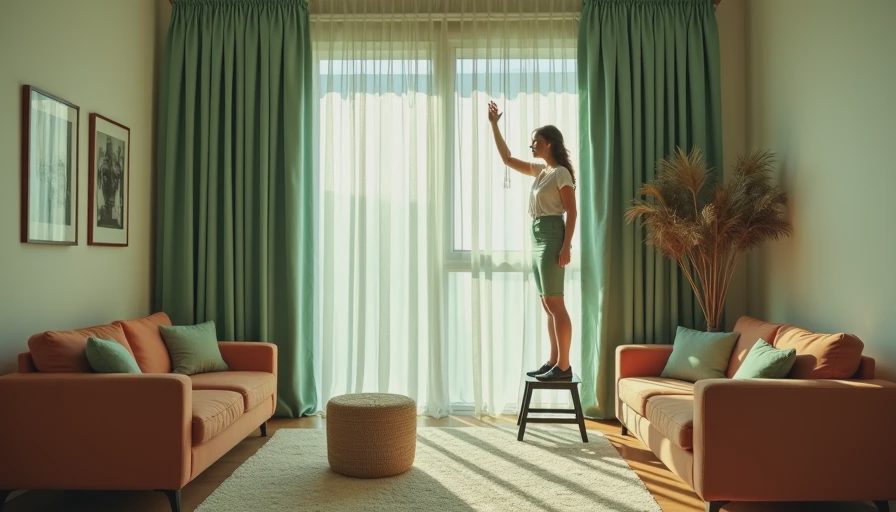
You don't need custom panels in every room. A powder room can use an off-the-rack rod. But for living spaces and bedrooms, spend where you sit still and sleep. If you're handy, buy custom panel sizes from online fabricators and install your own header tape to save money.
Don't forget the rod. People spend $400 on custom panels then hang them on a flimsy telescoping rod. Set aside at least $60 for a solid traverse rod with mounting brackets.
A Winter Window Test: What Good Drapes Actually Do
Last January at a friend's house in St. Paul, we installed a pair of 270-GSM cotton velvet drapes lined with a high-loft cotton-poly batting and white thermal backing on north-facing steel casement windows. The room temperature stabilized within half an hour. The draft didn't disappear, but the 2 feet of air around the window became comfortable.
We used a laser thermometer. The inside glass surface went from 44°F to 58°F by evening — not from sun, but from the air gap trapped between the curtain and glass. That's the real value of custom size curtains. A standard panel that stops 6 inches above the sill or leaves a 4-inch gap won't create that air pocket. A properly fitted panel that kisses the floor does.
Whether you're in Minneapolis or anywhere with real winters, the same rules apply: choose a tightly woven fabric, add a good lining, and get the drop right. Custom size curtains aren't a luxury; they're a performance upgrade that keeps your rooms comfortable all year.



No letters yet — be the first to write.