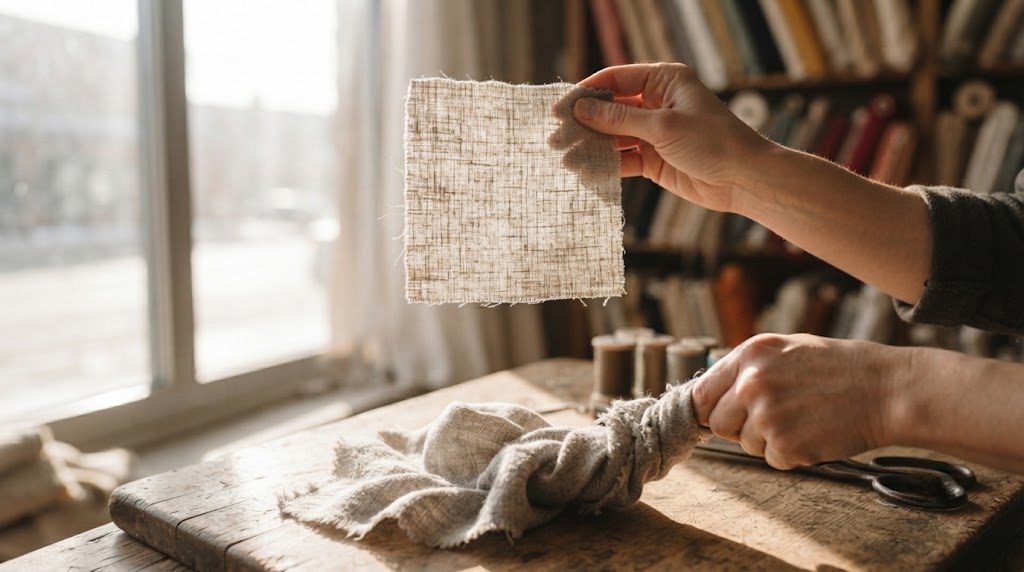
Store lighting is a liar. Those warm, recessed spots make every fabric look rich, dimensional, and exactly the color you want. Then you get the curtain home, hang it in your north-facing bedroom, and discover it’s flat, stiff, and entirely the wrong shade. The label won’t save you either—"linen blend" can mean almost anything, and thread count tells only part of the story. The solution isn’t a better label. It’s a better test.
These three simple evaluations work on any swatch, in any store, in under a minute. No tools required except your eyes, your hands, and a light source. Retailers probably won't stop you. But they definitely hope you won't think to do them.
The Crinkle Test: Finding the Fiber's True Identity
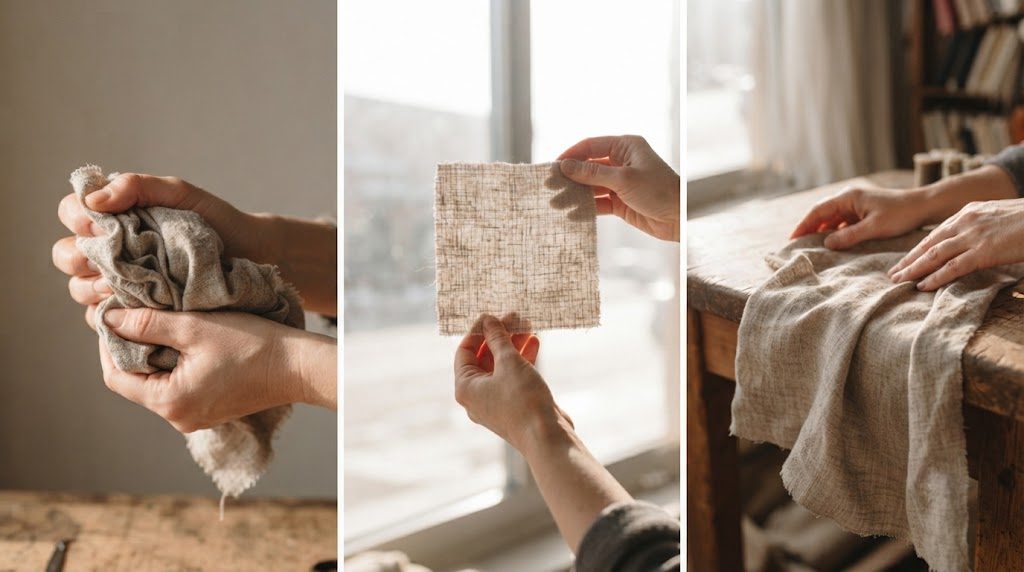
Fibers have a memory. Crumple a fabric tightly in your fist for five seconds, then release it and watch what happens.
How to Do It
Grab a corner of the swatch and squeeze it hard into a ball. Hold for five seconds. Open your hand and observe the recovery over the next ten seconds.
What to Look For
If the fabric springs back almost completely smooth with only faint creases, you’re handling a polyester or a poly-dominant blend. That resilience is great for a kitchen or bathroom curtain that needs to look fresh with zero effort.
If it holds sharp, defined wrinkles that stay put, you’ve got significant cotton or linen content. Pure linen will show deep, angular creases that barely relax. Cotton will wrinkle less dramatically but still hold some shape. This isn’t a flaw—it’s the natural behavior of cellulose fibers. For a relaxed, organic look in a living room, those wrinkles are part of the charm. For a boardroom, they’re a problem.
The Light Test: Seeing What the Weave Hides
A fabric’s color and opacity look completely different with light shining on it versus through it. In a store, lights are above; at home, the brightest light comes through the window. You need to test both directions.
How to Do It
Walk the swatch over to the nearest window—or the brightest ceiling light you can find. First, look at the fabric with the light hitting its front surface. Then, hold it directly against the light source and look through it.
What to Look For
With front light, you’re judging color and surface texture—this is what the room sees. With backlight, you’re judging weave density and true opacity. A fabric that looked solid on the bolt may reveal itself to be loosely woven when backlit, letting in more light than you expected. For a bedroom curtain, you want minimal pinpricks of light visible through the weave. For a living room sheer, those gaps are intentional.
This test also catches a common labeling trick: fabrics sold as “blackout” that rely on a thin, sprayed-on coating rather than a dense weave. Hold a coated blackout up to the light and look for pinholes or uneven coverage—those are failure points that will only grow over time.
The Drape Test: Predicting How It Will Hang
A fabric can feel lovely in your hand and still hang like cardboard on a rod. Drape—the way fabric falls under its own weight—is the combined result of fiber, weave, and finishing. The only way to judge it is to simulate a small-scale hang.
How to Do It
Drape the swatch over the edge of your hand, a table, or a display rod if one is available. Let about six inches hang freely. Gently nudge it and watch how it falls into folds.
What to Look For
A fabric that drapes well will form soft, rounded folds that flow downward like slow liquid. This is typical of heavier cottons, linen blends, and quality velvets. A fabric with poor drape will stand stiffly away from your hand, forming sharp, angular bends. Cheap, lightweight polyester often fails this test—it wants to hold its flat shape, which translates to a curtain that looks plastic and never settles properly.
The drape test is also where you’ll discover whether that "linen blend" has enough natural fiber to behave like linen. Real linen has a distinctive, slightly crisp fall that synthetics can mimic only in still photos, never in motion.
Putting the Three Tests Together
A crinkle, a backlight check, and a drape. That’s thirty seconds of focused attention. Walk into your next curtain appointment knowing that no salesperson, website photo, or marketing term can override what your own hands just learned. The swatch never lies.


No letters yet — be the first to write.