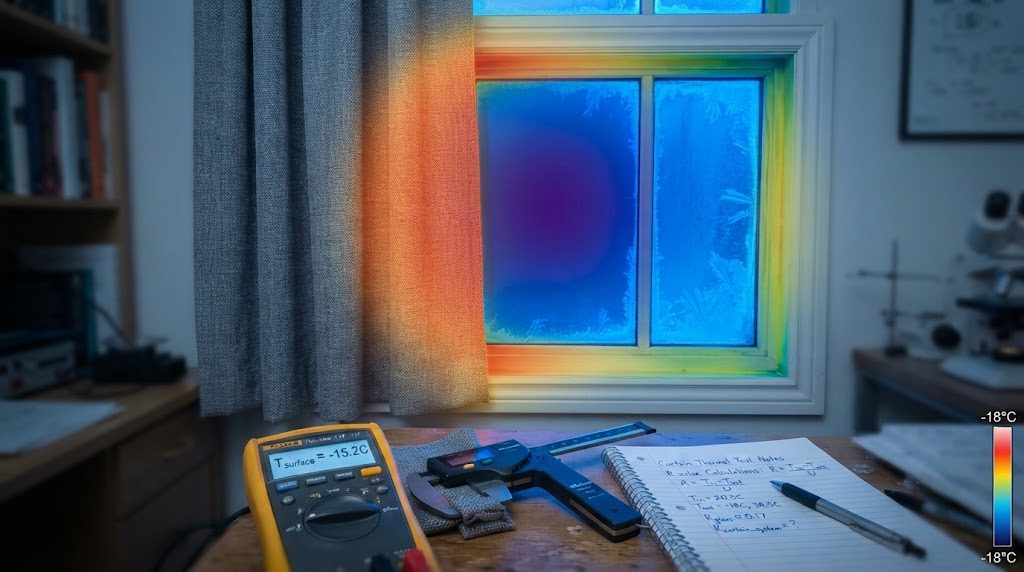
Walk through any home goods store in October and "thermal" curtains appear like clockwork. The packaging promises energy savings, draft reduction, and lower heating bills. Some even print R-values on the label, implying the same rating system used for attic insulation. The implication is clear: buy these curtains, and your window becomes a wall.
The reality is more complicated, and some of those numbers are marketing fiction. Understanding the actual thermal performance of a curtain requires knowing what R-value means, how fabric creates insulation, and why most "thermal" labels tell only a fraction of the story.
What R-Value Actually Measures
R-value measures thermal resistance—a material's ability to slow heat transfer. The higher the number, the better the insulation. An uninsulated single-pane window has an R-value of approximately R-1. A typical insulated exterior wall in a modern home rates around R-13 to R-19. A curtain, even the best one, will never approach wall-level insulation. The question is how much of that R-1 window you can improve, and for how many hours a day.
The Physics in Plain Terms
Heat moves through a window in three ways: conduction through the glass, convection via air currents, and radiation. A curtain addresses all three but primarily convection and radiation. The fabric creates a still-air pocket between itself and the glass. Still air is a decent insulator—roughly R-0.7 per inch. The curtain also blocks radiant heat loss from your warm body to the cold glass. These effects combined explain why a curtained window feels warmer than a bare one, even if the room's air temperature hasn't changed.
Where Thermal Claims Go Wrong
A packaging label claiming "R-6 thermal curtain" is almost certainly misleading. A single layer of even the densest drapery fabric provides an effective R-value of roughly R-1 to R-2 when properly installed and closed. The number can climb higher with specific constructions—interlining, multiple layers, and tight edge seals—but a standalone curtain panel achieving R-6 would need to be several inches thick.
Where do those inflated numbers come from? Some manufacturers test fabric-only samples under ideal laboratory conditions, ignoring the gaps at the top, bottom, and sides of a real installation. Others use different testing standards not intended for window applications. The most honest thermal curtains don't advertise an R-value at all—they give you the specifications that let you estimate real performance: fabric weight, number of layers, and whether the panel is designed for tight edge closure.
What Actually Improves a Curtain's Insulation
Density Over Thickness
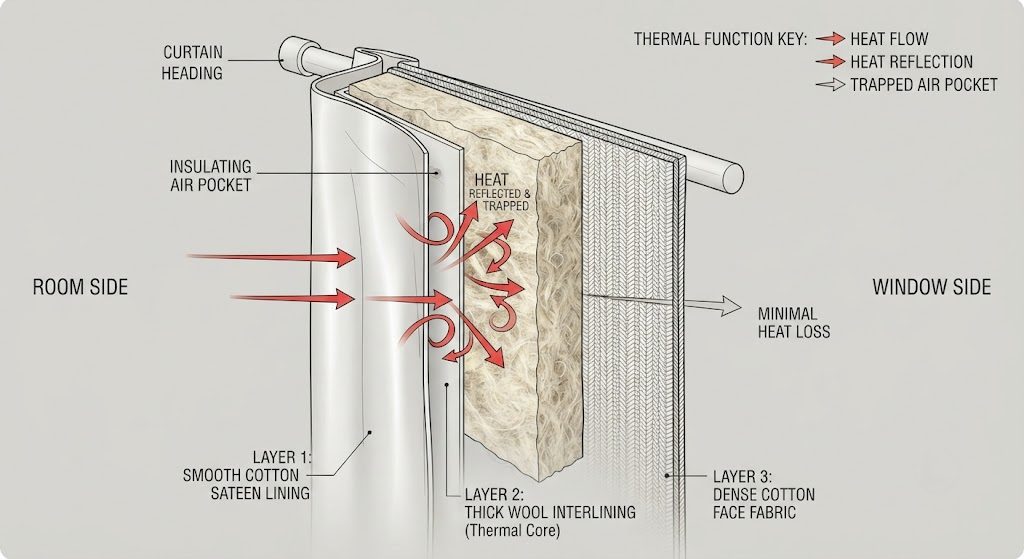
A dense, tightly woven cotton or wool fabric insulates better than a loosely woven one of the same weight because it traps air in smaller pockets and slows convective movement through the weave. The fabric weight, measured in ounces per square yard or grams per square meter, is a rough proxy—but weave density is the real mechanism.
The Interlining Effect
An interlining is a layer of felted fabric—typically wool, cotton, or polyester fleece—sandwiched between the face fabric and the lining. This middle layer is the true thermal engine of a good curtain. It adds R-value without dramatically increasing weight, and it breaks up air circulation inside the curtain structure. A properly interlined curtain can measurably outperform an unlined one of the same face fabric.
The Edge Seal That Changes Everything
A curtain that hangs six inches from the wall, stops short of the floor, and leaves gaps at the sides is leaking most of its insulation. Warm air rises behind the curtain, cools against the glass, and drops out at the bottom as a draft. To achieve meaningful thermal performance, the curtain must seal at the top with a covered pelmet or tight-to-ceiling mount, extend well beyond the window frame on both sides, and reach either the floor or a windowsill with minimal gap. These installation details often matter more than the fabric itself.
What to Look For Instead of an R-Value
Ignore the marketing number. Look for curtain construction that signals thermal intent: a face fabric with high thread density, a sewn-in interlining layer, a separate lining, and enough width and length to achieve edge seal when closed. Heavier isn't always better—density and layering are. The best thermal curtain I've ever tested was a heavyweight cotton duck with a wool interlining and a tight cotton sateen lining, mounted on extended brackets and paired with a covered pelmet. It never said "thermal" on the label. It didn't need to.



No letters yet — be the first to write.